

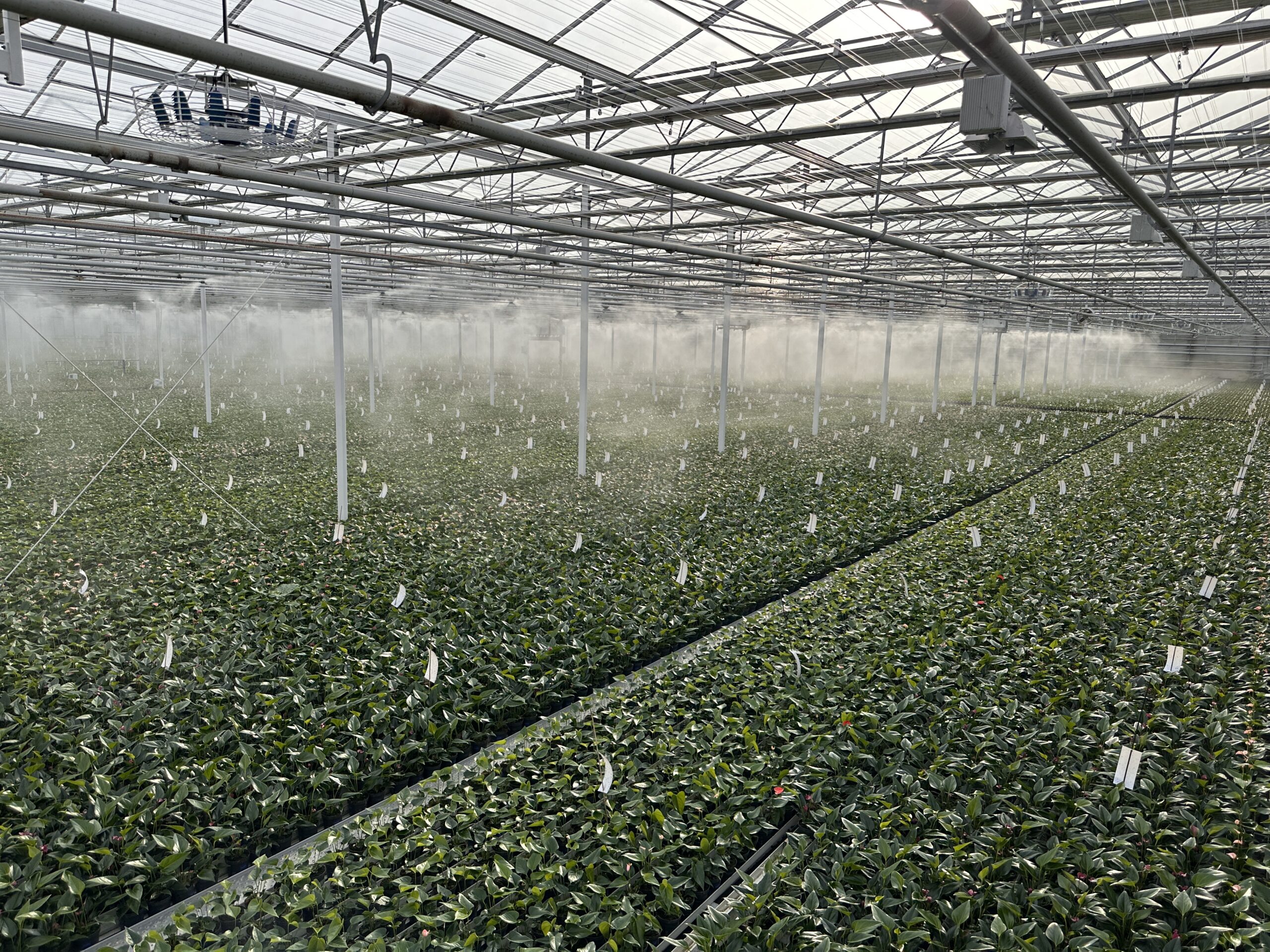
Optimal greenhouse humidity: target values per crop
Optimal greenhouse humidity is a recurring daily question for every grower. Too dry, and the crop transpires too much moisture, causing stress and potentially slowing growth. Too humid, and you risk increased disease pressure and a less active crop. Growers who can precisely control relative humidity (RH) and vapour pressure deficit (VPD) lay the foundation for a stable greenhouse climate and a healthy, uniform crop. This article explains what the target values per crop mean, how to interpret them, and how a 100 bar high-pressure fogging system can help.
Why relative humidity (RH) matters so much for your crop
Relative humidity largely determines how much moisture a plant can release through its stomata. If the air is too dry, the crop transpires faster than the water can be absorbed. This leads to increased transpiration demand and can disrupt the balance between water uptake and water release. If the air is too humid, transpiration decreases, which can slow down nutrient uptake and crop activity.
Alongside RH, growers increasingly rely on VPD (vapour pressure deficit, or moisture deficit): the difference between the amount of water vapour the air can hold and the amount actually present. Combined with temperature, VPD provides a more precise picture of the transpiration pressure on the crop than RH alone. Research from Wageningen University & Research (WUR) on the effects of humidity on growth and development (Anja Dieleman, Wageningen UR Greenhouse Horticulture, Report 519, 2008) shows that humidity affects processes such as transpiration, stomatal opening, photosynthesis, cell elongation and calcium uptake, and that humidity that is too low or too high can therefore have measurable effects on crop growth.
For growers, this means that controlling RH and VPD is not a matter of "the higher, the better," but of finding a range that suits the crop, the growth stage and the conditions in the greenhouse. Reducing plant stress therefore starts with preventing excessive fluctuations in RH and VPD, rather than chasing a single fixed value.
Target values for RH and VPD: the example of tomato
Target values differ per crop, per growth stage and per cultivation strategy. To make this concrete, we look at tomato, a crop for which agronomic guidelines are well documented. According to Yara's agronomic principles for tomato cultivation, the optimal relative humidity in protected greenhouse cultivation (substrate cultivation) ranges from 60 to 80%. VPD is also mentioned as a control parameter here, since it gives a more direct picture of transpiration pressure than RH alone.
It is important to emphasise that these target values are indicative and that the optimal range depends on factors such as variety, growth stage, lighting and the individual grower's cultivation strategy.
Other crop groups, such as ornamental crops, have their own target values for RH and VPD, which differ from those for tomato and are closely tied to the specific crop and cultivation goals. We deliberately do not provide separate figures for these, because a responsible target value is always determined on a project-specific basis, in consultation with the grower and based on greenhouse surface area, bay width, ventilation capacity and desired RH increase. Want to know which target values and which high-pressure fogging system suit your crop? Contact us for project-specific advice.
How a high-pressure fogging system (100 bar) precisely controls RH Lees ook: luchtvochtigheid verhogen met hogedrukverneveling.
To actually control RH and VPD, a system is needed that can introduce moisture into the greenhouse air in a fine and controlled manner. At Dutchbeek, this is done using high-pressure fogging at 100 bar. By forcing water under this high pressure through standard nozzles — with an opening of approximately 0.20 mm — extremely fine water droplets are created. Depending on the version and conditions, a nozzle delivers approximately 4.5 to 4.8 litres of water per hour.
All water flows through stainless steel piping, which contributes to a stable and reliable system over a long service life. The fine droplet size is essential: the smaller the droplet, the faster it can evaporate into the greenhouse air, and the more precisely the RH increase can actually be controlled.
However, precise control does not start with the nozzle alone, but with the design of the entire system. The nozzle layout is therefore calculated per project, based on greenhouse surface area, bay width, ventilation capacity and the desired RH increase. This prevents too much or too little moisture from ending up in a particular part of the greenhouse, and allows the system to be tailored to the specific crop and greenhouse construction.
Control via the climate computer: RH, temperature and moisture deficit
A high-pressure fogging system does not operate on its own; it is controlled via the climate computer. Based on current measurements of relative humidity, temperature and moisture deficit, the climate computer determines when and how much fogging is needed. This means fogging is applied at the moments the greenhouse climate requires it, rather than at fixed times.
This makes the control dynamic: when temperatures rise and RH drops, the system can adjust in time, while at already high humidity levels, fogging is scaled back. Because the climate computer continuously measures and adjusts, a climate is created that better matches the crop's needs, without large fluctuations. Periodic inspection is important for maintaining this precise adjustment; through our service and maintenance, we ensure that the system and its control keep functioning reliably.
Does fine fogging result in a wet crop?
A frequently asked question from growers is whether fogging simply leads to a wet crop. The answer is nuanced. In a well-designed system, the droplets evaporate before reaching the crop, making the greenhouse air more humid without wetting the leaves themselves. Design, nozzle layout and control are decisive here.
This means that the risk of a wet crop is closely linked to the quality of the system design: if the nozzle layout is well matched to the greenhouse and ventilation, and the climate computer controls precisely, fogging remains limited to fine, quickly evaporating droplets. A less carefully designed or poorly adjusted system can indeed lead to moisture build-up on the crop. That is why we always recommend a project-specific calculation, so that the nozzle layout and control match your specific greenhouse and cultivation situation.
When is fogging less effective?
High-pressure fogging is a powerful tool for increasing RH, but its effectiveness depends on the conditions in and around the greenhouse. At very high outdoor humidity or very limited ventilation, the evaporative capacity of the air is low, which limits the effect of fogging. In that case, the air simply cannot absorb much extra moisture, regardless of how fine the droplet is.
This is an important nuance: a guaranteed temperature reduction or RH increase cannot be given without a project-specific calculation. The effect of fogging always depends on factors such as outdoor climate, ventilation rate, greenhouse construction and the chosen nozzle layout. We are happy to calculate this for you, so you know what to expect in your specific situation.
Frequently asked questions (FAQ)
What is the difference between RH and VPD?
RH (relative humidity) indicates how much moisture the air contains relative to the maximum amount possible at that temperature. VPD (moisture deficit) combines RH and temperature into a single value that represents the transpiration pressure on the crop. VPD is therefore often seen as a more precise control instrument.
Which RH is optimal for my crop?
This differs per crop, variety and growth stage. For tomato, sources such as Yara and WUR provide guidelines that can serve as a starting point, but the optimal range is ideally determined per project and per cultivation situation.
Can high-pressure fogging also lower temperature?
Yes, temperature reduction is, alongside RH increase and reduction of plant stress, an important application of high-pressure fogging. The extent of the reduction depends heavily on project-specific factors and is therefore calculated per situation, not guaranteed.
Will my crop get wet from high-pressure fogging?
In a well-designed system, the droplets evaporate before reaching the crop. This depends on design, nozzle layout and control, and should therefore always be assessed on a project-specific basis.
How often does a fogging system need maintenance?
Regular maintenance keeps nozzles and piping in good condition and ensures that control via the climate computer remains precise. You can read more about this on our service and maintenance page.
In conclusion
Optimal greenhouse humidity is not about a single fixed value, but about a carefully tailored system that matches your crop, your greenhouse and your cultivation goals. With a 100 bar high-pressure fogging system, a precise nozzle layout and control via the climate computer, you lay the foundation for a stable climate in which RH, temperature and moisture deficit are in balance. Curious what this could mean for your greenhouse? Call to make an appointment, and we will be glad to think along with you about a project-specific design. Lees ook: neem contact met ons op.
